Home WMS Control GIS FSM PBW Pricing Security Knowledge base
Statutory deadline 31 Dec 2026 Risk assessment and WSP ↓ An operations platform for water utilities

Order in water intake operations

Data instead of binders, deadlines instead of reminders

Intake records, pump monitoring, the network map and field crew work in a single system, available from a browser. The manager sees the state of every well, and the application keeps track of statutory deadlines.

Free consultation No quote, no price list, we simply get to know each other.
We call back within 24 hours on business days.
Water is usually not the problem. The problem tends to be the layer that describes it: documentation, deadlines and measurements scattered across departments.
01 Because
"I don't know which permit expires next"
intake records, pump telemetry, the network map and crew work orders all sit on one database
A well, its permit, its pump, its electricity consumption and its last work order form one record, not four files in four departments.
02 you sort it out with a single implementation
"The water permit report is somewhere in the archive"
the paper archive enters the system through AI reading, with no manual re-typing
You upload decisions, asset records and test results as scans, and the system prepares draft entries. We take care of configuring the structure and the reports.
03 and operations become predictable
"One person keeps track of the deadlines"
no statutory deadline depends on anyone's memory any more
A report closes without ringing round the departments, a pump failure reports itself, and an energy cost overrun is visible at the asset, not on the aggregate invoice.
Statutory deadline

Drinking water risk assessment: 31 December 2026

This date is not negotiable

Directive 2020/2184 requires an assessment across three layers: the intake catchment area, the supply system and the installations in priority premises. The input data takes months to gather, not the week before the deadline.

The WSP module handles this: a water safety plan inside the operations logbook. In it you prepare the input data, send a pack to the assessor, load the finished assessment back in and maintain the registers of hazards, control measures, incidents and corrective actions.

Let's check your deadlines
Three assessment layers
01The intake catchment area together with external hazards
02The supply system from the well to the distribution network
03Internal installations in priority premises
A second deadline in the same year
The tariff application is filed no later than 120 days before the current tariff expires. Abstraction and energy cost data has to be ready by then, not still being collected.

Five modules, five concrete outcomes

Each one works on its own. Expand the one that describes your problem today. The newest of them, WSP, handles water safety plans and risk assessments.
The entire intake life cycle in one place: from the well record sheet to the annual report.

What you get
-A digital well operations logbook across twelve tabs: record sheet, water levels, abstraction, quality, maintenance, failures, inspections, pumping tests
-Asset records across six levels, from the branch down to a single device
-Water permit statuses and reporting deadlines visible on the dashboard from the first login
-Report wizards for Polish Waters, the Central Statistical Office, the Sanitary Inspectorate and the waste database, with a workflow from draft to confirmation
-AI reading that loads decisions, record sheets and test results as drafts with a marked confidence level
-Drinking water risk assessment across three layers, in line with Directive 2020/2184
Who it is for
Utilities that no longer want to enter data into many separate files
The pilot starts with
Importing permits and regulatory deadlines
Wms
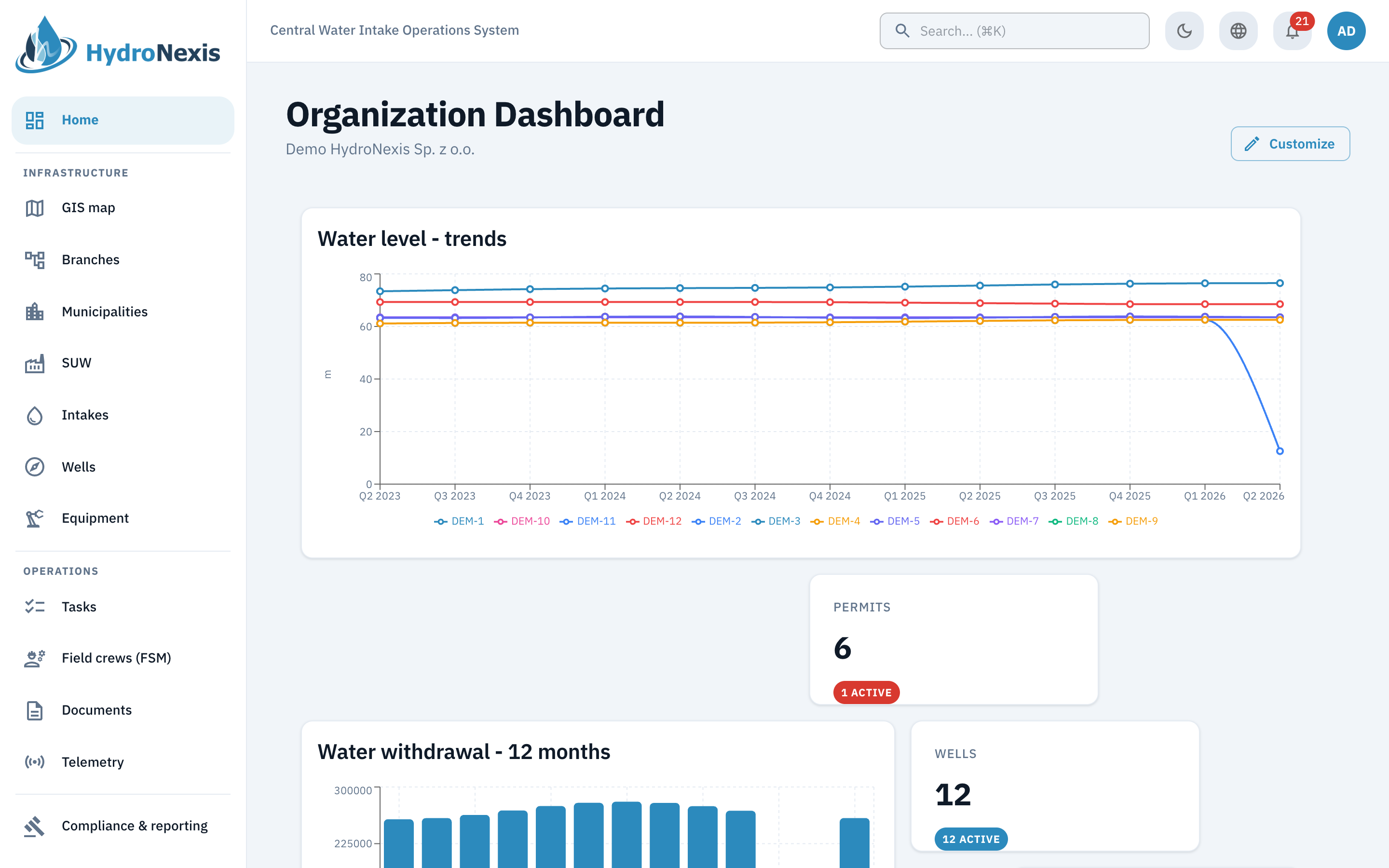
Organisation dashboard: water level trends, permit counts and twelve months of abstraction.
What you keep in your hands
An asset file on demand

The complete set of documents, tests and history for one well in a single file, ready to hand to an inspector.

What you keep in your hands
A report in the authority's format

A completed form with its workflow history and a PDF export, instead of a spreadsheet stitched together from three sources.

What you keep in your hands
Data in an open format

Export of the entire database throughout the contract, without asking our permission and with no exit fee.

Comparison

HydroNexis versus Excel, paper and a network drive

Spreadsheets and binders work. Up to a certain scale they are even the cheapest option. Below is an honest comparison of where they stop being enough, and where they still have the advantage.

Situation
Excel, paper, network drive
HydroNexis
Water permit deadline
Tracked by whoever remembers. When they leave, the knowledge leaves with them.
VALID, CRITICAL and EXPIRED statuses on the dashboard and alerts 90, 60 and 30 days before the deadline.
Reporting to Polish Waters and the Central Statistical Office
Collecting data from several spreadsheets and re-typing it into the form.
A wizard pre-filled with operational data, a workflow from draft to confirmation and a PDF export.
A pump failure at night
You hear about it from residents or on the morning round.
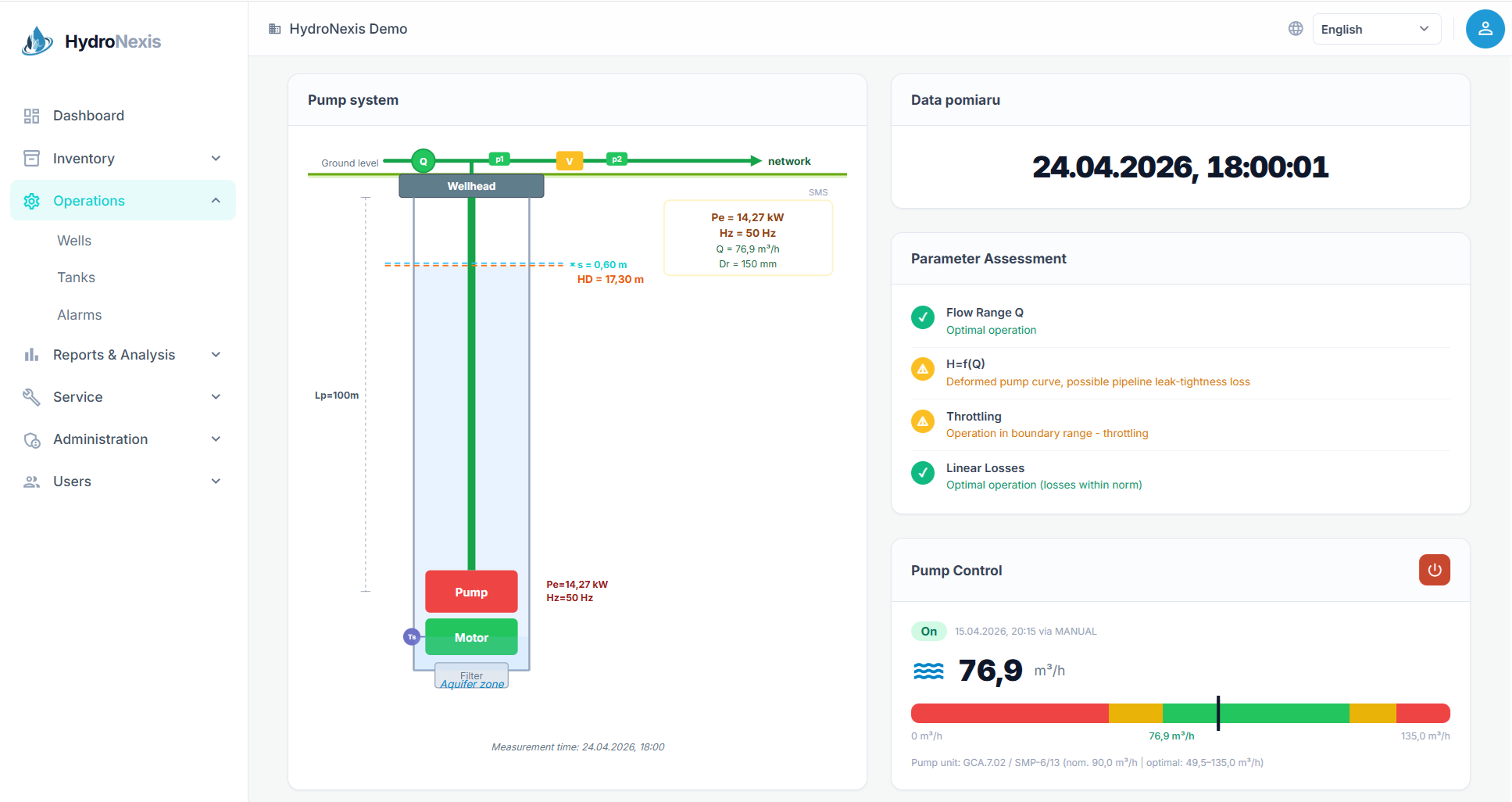
An alarm from the asset in the register plus a notification, and remote pump shutdown with the operation logged.
Energy cost control
The aggregate invoice shows a total. You cannot see which asset is generating it.
kWh/m³ and PLN/m³ indicators per asset, station benchmarking and detection of contracted power exceedances.
Audit and NIS2
No trace of who changed a value in a file, or when. Version history depends on the drive.
Roles and permissions, an audit log of control operations, versioning instead of deletion.
Cost to start
Here the spreadsheet wins. Zero licence cost and zero implementation.
A subscription or licence plus implementation. For early customers the 60-90 day pilot is free.

If you have a handful of wells, one member of staff keeping the records and a stable electricity bill, a spreadsheet is still a sensible choice. A conversation makes sense when one of the rows above describes a real problem from the past year.

Loss calculator Work out on your own figures what today's way of working costs.
The cost of inaction

Keeping things as they are costs money too

We have filled the fields with values typical of a mid-sized water utility in 2026, so the result means something straight away. Your figures will differ, so it is worth replacing them.

Administrative work
Site visits
Pump energy
The cost of today's way of working
Administrative work— / month
Check visits— / month
Month —
Year —
Three years —
Pump energy, separately
Month —
Year —
Three years —

Control breaks this amount down by asset and reports kWh and PLN per cubic metre. How much of it can be recovered is known after the first month of measurements, not from a calculator on a website.

Month —
Year —
Three years —

The result comes solely from the values entered alongside. We add no coefficients of our own and no industry averages.

Every change in these fields recalculates the result alongside immediately. Leave a field empty if that item does not apply to you.
For the buying committee

Several people sign off the decision, and each of them fears something different

Below is the argument for each of them, written for their area of responsibility. You can forward it on without having to explain what it is about.

The answers are deliberately short. Each one expands on a separate module page or in conversation.

The chief executive's most common questions

You find out about an expired permit from a letter, not from your team. Not because people are careless, but because nobody has the full picture in one place.

How will I know a deadline is approaching?

From the dashboard you open in the morning. Every permit carries a valid, critical or expired status, and alerts go out 90, 60 and 30 days before the deadline to the people you nominate. You stop depending on whether someone remembered to put a date in the calendar.

What do I show when someone asks about documentation?

The digital operations logbook for every well and the full set of reports with their workflow history, in minutes rather than two days. The audit log shows who changed an entry and when, and records are versioned, not deleted.

What happens when the person who knows all this leaves?

Nothing that cannot be reconstructed. The knowledge sits in the system, not in their binder and not in their memory. Their successor steps into the full history of assets and deadlines without a two-week handover at the desk.

Am I tying myself to you for years?

No. Data is portable throughout the contract, with export to open formats, and in the on-premise variant the installation runs on your server without our involvement too. You stay with us because it pays off, not because you have no way out.

A one-page summary for the board
The problem, the cost of delay, the pilot scope and the cost structure. To print and put on a desk.
Open the summary
Send this summary to your committee

Four sets of questions and answers in one file, one page per role. No newsletter sign-up and no phone call unless you leave a number.

Who is behind this

A team that knows intake operations from the working end

Where public money is involved, what matters is who is accountable for the implementation and on what terms it can be tested. We show both: the team by name and the scale of live deployments, which you can verify at no risk.

Dominik Wolski
CEO

Responsible for product direction and contact with operators. Knows intake operations from the working end.

Paweł Broniarek
COO

Operations, contracts and conversations with procurement departments. Previously built a manufacturing business selling into export markets.

Karol Wolski
Tech Lead

Platform architecture and integrations with customer systems. Ten years working on enterprise-class systems.

Pascal Zatorski
AI Engineer

Telemetry, control systems and models that detect anomalies in pump operation.

Where the platform is already running

We run an early access programme with operators in the water sector. We do not name customers at their request, but we can show the scale.

4
branches
33
municipalities
212
stations with intakes
117
wells

This is the largest deployment to date. It holds around 2,100 documentation files in the system.

Early access programme, 2026 edition

Space for concrete deployment figures: the number of assets, the module scope and the project stage. We will fill them in once partners release this information from confidentiality.

This is not for you if
-you have a handful of wells and one person who keeps on top of the deadlines without difficulty
-you are looking for a customer billing system, because we do not do that
-you need a supplier with a ten-year deployment portfolio this month
Price

What our price is made of

Pricing is individual, because two utilities with the same number of wells can have an entirely different scope. Below is everything that affects it, ordered by how strongly it does so.

Factor
Impact
What exactly we count
Number of assets
Intakes, wells, reservoirs, pumps and treatment stations in the system
Number of modules
WMS, Control, GIS, FSM, WSP - each priced separately, and you can start with one
Integration scope
Existing SCADA, telemetry, billing, ERP. You can deploy without integration and add it later
Deployment model
Cloud means a subscription, on-premise means a licence plus a support agreement
Archive migration
A one-off cost. The more that can be loaded by AI reading, the lower it is
Number of users
People with their own login. We count field accounts differently from office ones
Starting point
We give a range in the first conversation

The smallest deployment: one module, cloud, no integration, up to 20 assets. Greater scale raises the amount in line with the table alongside.

The 60-90 day pilot in the early access programme is free.

What the subscription does not include

-Measurement hardware: probes, transmitters, telemetry controllers. Settled with the suppliers.
-Data transmission from assets, meaning SIM cards and GSM plans.
-Electrical and installation work on site.
-The server and its upkeep in the on-premise variant.
-A custom report template outside the standard list.
Free consultation Three numbers are enough: assets, users, cloud or your own server.

The three things we hear most often

The doubts arrive in the same order: first about whether the change makes sense, then about how it would be implemented, and finally about the price and the supplier. We answer all three here, without waiting for a conversation with a salesperson.

Level 1 - whether the change makes sense

"We have managed without it for years"

And that is true, because so far nothing has gone wrong. The problem is that this way of working does not cost a little each month; it costs all at once, at the least convenient moment: during a failure, or when the person who remembered the deadlines leaves.

Work through the calculator above on your own figures. If the result is low, you will see it for yourself and we will leave you alone.

Level 2 - how it is implemented

"The rollout will paralyse our work"

That is usually how it ends when the entire burden sits with the customer. With us the account is live in 1-3 business days, and archive import, report configuration and training run alongside normal work, typically over 2-6 weeks.

AI reading loads the documents and prepares drafts with a marked confidence level. Your member of staff approves instead of re-typing. That is the difference between a week and a quarter.

Level 3 - price and supplier

"We have found a cheaper system"

Very possibly. In that case ask it three questions: does it handle Polish regulatory reporting without surcharges, can it be installed on your server, and who picks up the phone on a Sunday when a pump stops.

If it answers all three, it is the better choice and we will tell you so. We have no interest in talking you into a worse decision.

Next step

What happens after you click

No sales presentation at the first meeting and no calling twice a day. For each step we say how long it takes.

1
The form and our call back within 24 hours

Two fields in the form, and within 24 hours on business days one of our team gets in touch. This contact serves solely to agree a time and who on your side should be in the conversation.

2
Free consultation no quote

We ask about your infrastructure, your deadlines and your biggest bottleneck. We show no quote and no price list. If it turns out we are not a good fit, we say so in that conversation.

3
Meeting with the buying committee 60 minutes

Everyone who will sign sits down together: the board, engineering, finance and IT. Each is accountable for something different, so we put the concept and the offer together with them rather than bringing a finished one. The scope, the schedule and the cost range come out of that meeting in writing.

4
A decision, either way Your timing

We settle whether we go ahead. If you decide this is not the moment, we accept that without persuasion and without calling every fortnight. We would rather hear an honest no than carry on a conversation with nowhere to go. We come back when you tell us to.

Leave your details and we will call back

Not sure which module would suit you best? We will work it out in a short call. Two fields, and we settle the rest by phone.

We call back within 24 hours on business days. Consent can be withdrawn at any time by writing to biuro@hydronexis.pl. We do not sign anyone up to a newsletter.

Prefer to call? +48 662 640 450 biuro@hydronexis.pl Mon-Fri, 8:00-16:00
Scan with your phone

Materials and contact at hand

The code opens the page directly on your phone. You will find the same set at our trade fair stand.


Book a free consultation
Contact form, takes 30 seconds to complete
Kod QR: Umów bezpłatną konsultację
hydronexis.pl/demo
Platform catalogue 2026
PDF: five modules, implementation, data security
Kod QR: Katalog platformy 2026
hydronexis.pl/katalog
WSP - a statutory obligation
The module sheet and the risk assessment rollout path
Kod QR: PBW - obowiązek ustawowy
hydronexis.pl/pbw
Team contact card
Contact details for the people you are speaking with
Kod QR: Wizytówka zespołu
hydronexis.pl/kontakt
Questions and answers

The ten questions we are asked most often

Every answer opens with the verdict, so it can be read without the context of the whole page.

How much does a HydroNexis implementation cost?
Pricing is individual, and for early customers the 60-90 day pilot is free. Six things affect the price: the number of assets, the modules selected, the number of users, the integration scope, the deployment model and the scope of implementation work. We prepare a quote within 5-10 business days of the first conversation.
How long does implementation take?
We activate the account in 1-3 business days; a full implementation typically takes 2-6 weeks. The team works in the system from day one, while historical data import, report configuration and training run in parallel.
Do all the modules have to be deployed at once?
No. Each module works on its own. Most often it starts with WMS where documentation and deadlines are the problem, or with Control where pumps are. Further modules are added to the existing contract without starting a new implementation from scratch.
Can the data stay on our own network?
Yes, an on-premise deployment on your own servers is available. The default variant is Google Cloud in the EU region. Both options run the same software; they differ in where the data is stored, the billing model and who is responsible for the infrastructure.
Do you integrate with our SCADA and telemetry?
Yes, through a REST API and the Modbus, OPC UA and MQTT protocols. Control also has its own measurement layer: Aplisens probes and transmitters, and telemetry controllers from Polish suppliers. We agree the integration scope after reviewing the existing architecture.
Does HydroNexis replace a SCADA system?
No. SCADA handles real-time process control, while Control adds an analytical layer: pump diagnostics against its curve, energy intensity indicators per asset, and history and reporting. The two systems work together through a REST API and Modbus, OPC UA and MQTT.
Which regulatory reports does the platform handle?
Polish Waters, the Central Statistical Office, the Sanitary Inspectorate, the waste database, KOBiZE and E-PRTR emissions, and wastewater. Forms are pre-filled with operational data and run through a workflow from draft to confirmation. A non-standard format is prepared as a custom template as part of the implementation.
Will implementation halt the team's day-to-day work?
No. The account is live in 1-3 business days and the team works in the system from day one. Archive import, report configuration and training run alongside normal work, typically over 2-6 weeks. We launch the pilot on one district or one module, so existing procedures continue alongside.
What happens to the data if we end the relationship?
Data is portable throughout the contract, with export to open formats. The platform source code remains ours, and in the on-premise model the installation runs without our continued involvement.
Do you have references we can speak to?
Not publicly. The first pilot deployment is covered by a confidentiality clause, and we arrange a conversation with that partner for customers considering an implementation, once an NDA is signed. The HydroNexis team has previous projects in the well drilling sector and in enterprise-class systems behind it, but we do not present those as company references.

We have collected more questions, technical and formal ones included, in the knowledge base.