In development

GIS

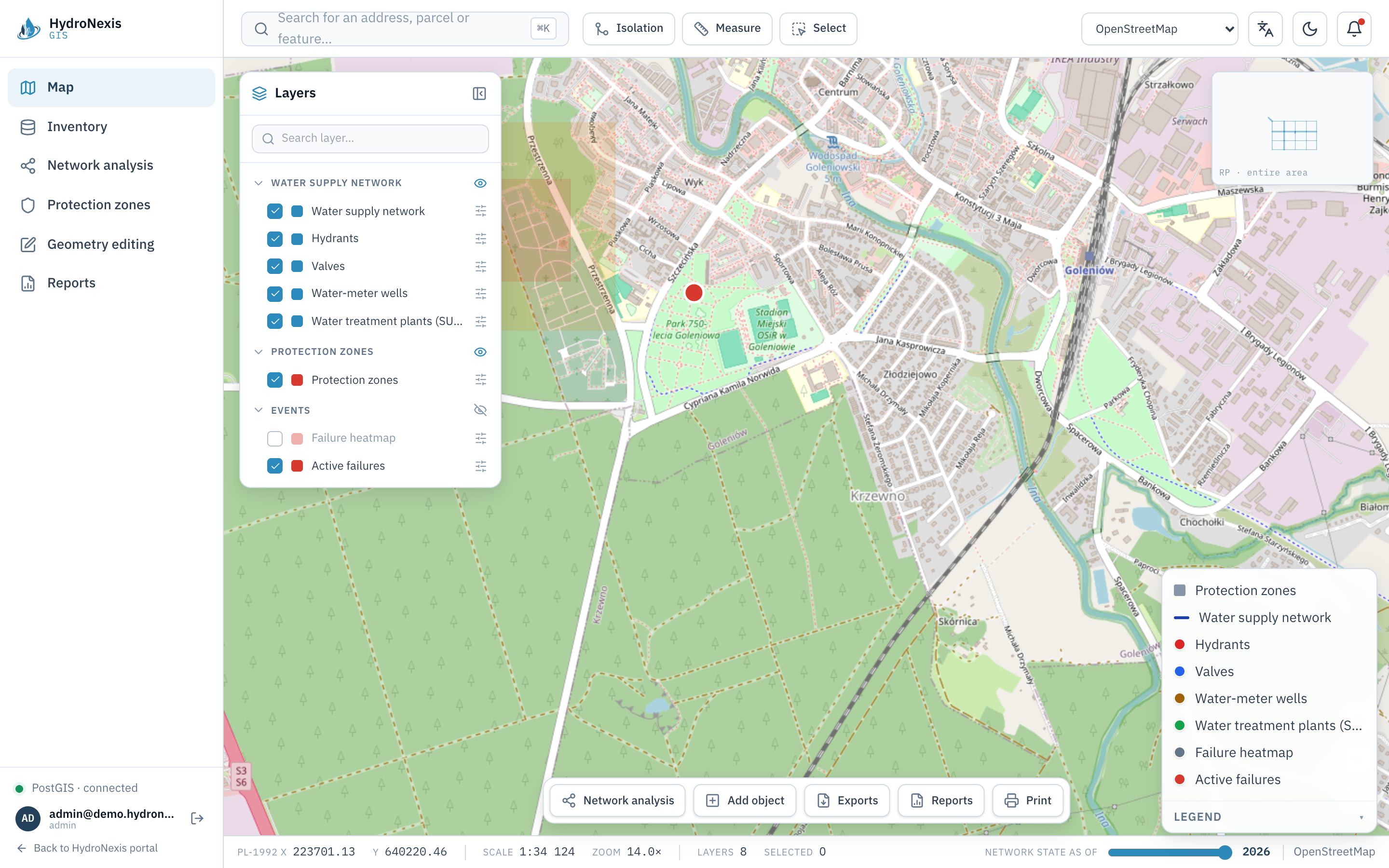
Geographic Information System - a central digital map of water and wastewater networks.

Full inventory of water and sewage networks with 25 classes of facilities, decision-making analyzes (failure cut-off, flow tracking), integration with your surveying resource, ready-made statutory reports and portals for residents and external designers.

Status: in the pilot phase with a partner from the water supply sector, in the on-premise model.Scale of the pilot: over 150 water intakes, water and sewage network at the provincial level.

+48 505 901 805

Demo of the GIS module available to selected customers in early access. After making an appointment, we will contact you with information about expected availability.

Digital map of the water and sewage network in the testing phase
first screens available after pilot

Who is GIS for

Surveyors and network engineers

People conducting inventory and editing networks - needing a tool with Polish symbology standards, coordinate systems and integration with your own geodetic resource.

Dispatchers

People responding to network failures - who need a live map with the ability to analyze the failure cut-off and identify customers affected by the interruption in water supplies.

Management and investment planning

People responsible for renovations, modernizations and multi-year budgets - who need to analyze the age and material of the network and identify priority sections.

External designers

Design offices working for water supply companies - needing a dedicated portal to download technical network data for their projects.

Key features

Nine functional areas covering the full cycle of work with a digital map of water and sewage infrastructure.

Digital network map

Full water and sewage network against the background of an orthophoto or cadastral map. Layer management, Polish coordinate systems (PUWG-1992, PUWG-2000), Polish standards for the symbolism of water and sewage facilities.

Inventory of 25 classes of objects

Pipelines, hydrants, gate valves, intakes, wells, SUW, pumping stations, tanks - 25 classes of water and sewage objects with attributes (material, diameter, year of construction). Compliance with the K-GESUT and BDOT500 standards.

Editing data from a 4-eye workflow

Editing sessions with optimistic locks, change approval workflow (4-eyes principle), full history of changes with time travel function - ability to view the network status from any date.

Failure cut-off analysis

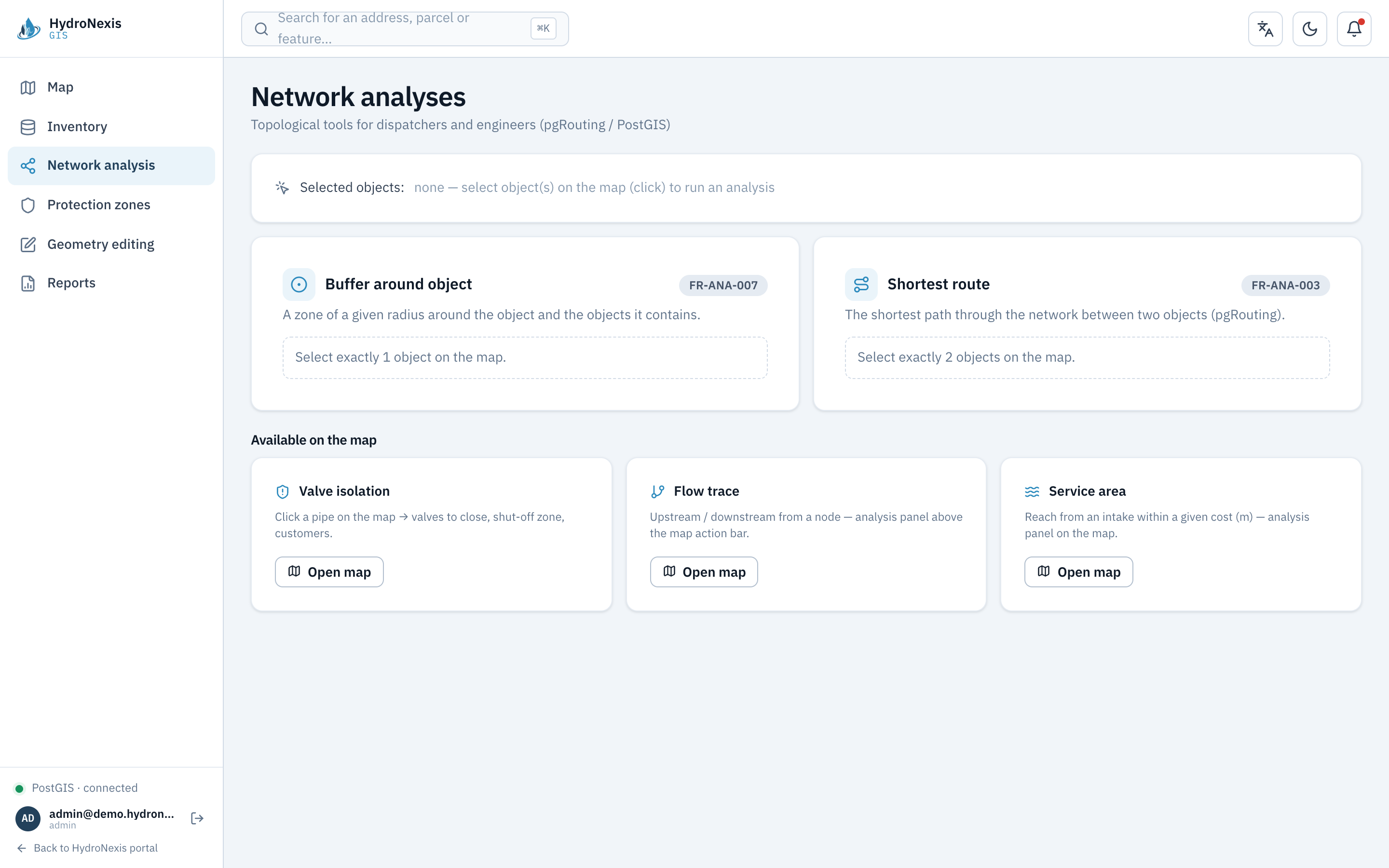
The key function of the decision engine - when a failure is reported, the system automatically designates the valves to close, identifies the power supply area and the list of customers affected by the interruption in water supply.

Investment planning support

Analysis of the age and material of the network, identification of sections for priority replacement, mapping of planned investments, ready-made data packages for external designers. Multiannual budget support.

Integration with geodetic resources

K-GESUT, BDOT500, EGiB (land records), EMUiA (addresses). Data validation by the official GML validator, support for the process of submitting surveying works to PODGiK.

Regulatory reports

national statistical office M-03, national wastewater treatment program, compliance report with the National Interoperability Framework, public health authority reports, multi-year reports - generated with one click with appropriate filters and export to PDF/Excel.

Public and designer portal

Portal for residents with information about failures and planned works. A separate portal for external design offices with access to data packages for their projects.

Wealth management

Property cards of facilities, fixed asset (KŚT) classification, network age report supporting renovation planning, technical documents related to facilities with OCR and global search.

Integrations in the HydroNexis ecosystem

GIS is the geographical core of the platform - it exchanges data with other modules and your geodetic resource.

CSZU

Common data model - intakes, wells, branches. GIS presents CSZU objects on a map and enriches them with geodetic attributes.

FSM

Auto-trigger of FSM tasks when reporting a failure in GIS - cut-off analysis automatically creates an order for the field brigade.

K-GESUT, BDOT500, EGiB

Full integration with your geodetic resource - data exchange, validation by GML validator, submission of works to PODGiK.

On-premise implementation

Full installation in the customer's infrastructure possible - compliance with data sovereignty requirements for critical infrastructure operators.

Frequently Asked Questions

The GIS module is currently in the pilot phase with a partner from the water supply sector, implementation in the on-premise model. Full commercial availability is planned after the pilot is completed and feedback is collected. Customers who request a demo at this stage can gain early access status with preferential terms and influence on development priorities.

The GIS module is designed in full compliance with Polish standards: K-GESUT (National GESUT Database), BDOT500 (Topographic Objects Database), EGiB (Register of Land and Buildings), EMUiA (Register of Towns, Streets and Addresses). Data validation is performed by the official GML validator, and the module supports the process of submitting surveying works to PODGiK. Polish coordinate systems (PUWG-1992, PUWG-2000) are supported natively.

This is one of the key elements of the GIS decision engine. When reporting a failure, the operator indicates the location on the map, and the system, based on the network topology, automatically determines the minimum number of valves to close, identifies the power supply area without water and the list of customers (addresses from EMUiA) affected by the supply interruption. Without GIS, such an analysis would require manual tracing of maps and consultations with several people - with GIS it takes seconds.

GIS generates ready-made statutory reports required from water supply operators: national statistical office M-03 report, national wastewater treatment program report (National Municipal Wastewater Treatment Program), compliance report with the National Interoperability Framework, public health authority reports, multi-annual reports. All with appropriate date and area filters, export to PDF and Excel. We update the report format in line with current regulatory requirements.

We carry out GIS pilots in the on-premise model - full installation in the client's infrastructure. This is a conscious choice for critical infrastructure operators where full sovereignty of geodetic and map data is required. After the commercial premiere, we are also considering a cloud variant (SaaS) for smaller water utilities. We establish a specific implementation model during a conversation about needs.

Yes. GIS is the geographic core of the HydroNexis ecosystem and is designed to work fully with the other modules. It shares a common data model with CSZU (intakes, wells, branches) - objects from CSZU are presented on a GIS map. Direct integration is planned with FSM: failure cut-off analysis in GIS automatically generates a task for the field brigade in FSM. HydroControl, on the other hand, presents its operational data on a GIS map as an additional information layer.

We are actively working with the first pilot partner in the on-premise model, but we are considering expanding the early access program to include additional water companies. Customers from the early access program receive preferential conditions, direct contact with the product team and influence on module development priorities. Just request a demo and indicate your interest in the pilot.

Request a Demo GIS

We will show the current status of the module and talk about the early access program.

+48 505 901 805